Cruise etiquette: the quiet rules nobody tells you about
Cruise etiquette refers to the unwritten rules on a cruise that passengers naturally follow onboard. These quiet rules help thousands of people share the same space smoothly, without the need for strict enforcement
What are the unwritten rules on a cruise?
It was about time to talk about the quiet rules on a cruise. And not because, finally, it is quiet, after I managed to put a mischievous child to sleep. And I don’t have a glass of Sauvignon Blanc in my hand either (a note for my colleague). So, cruise ships have rules. Some are written, others are announced. Most of the time they appear printed in brochures or through various apps.
If you want to understand how life onboard actually works step by step, you can start with this full guide:
👉 What happens on a cruise
But the rules that truly shape life onboard are rarely clearly explained. They are learned quietly, through observation, through small reactions. Through moments when you realize that something worked — or didn’t.
You should know that we are talking about rules that are not imposed by authority, but only by the perfect rhythm of the ship. They are rules that, in fact, are normality on board such a large vessel so that it functions perfectly. In many ways, this is what cruise ship etiquette actually means in practice.
Rule #1: Space is shared, even when it feels private
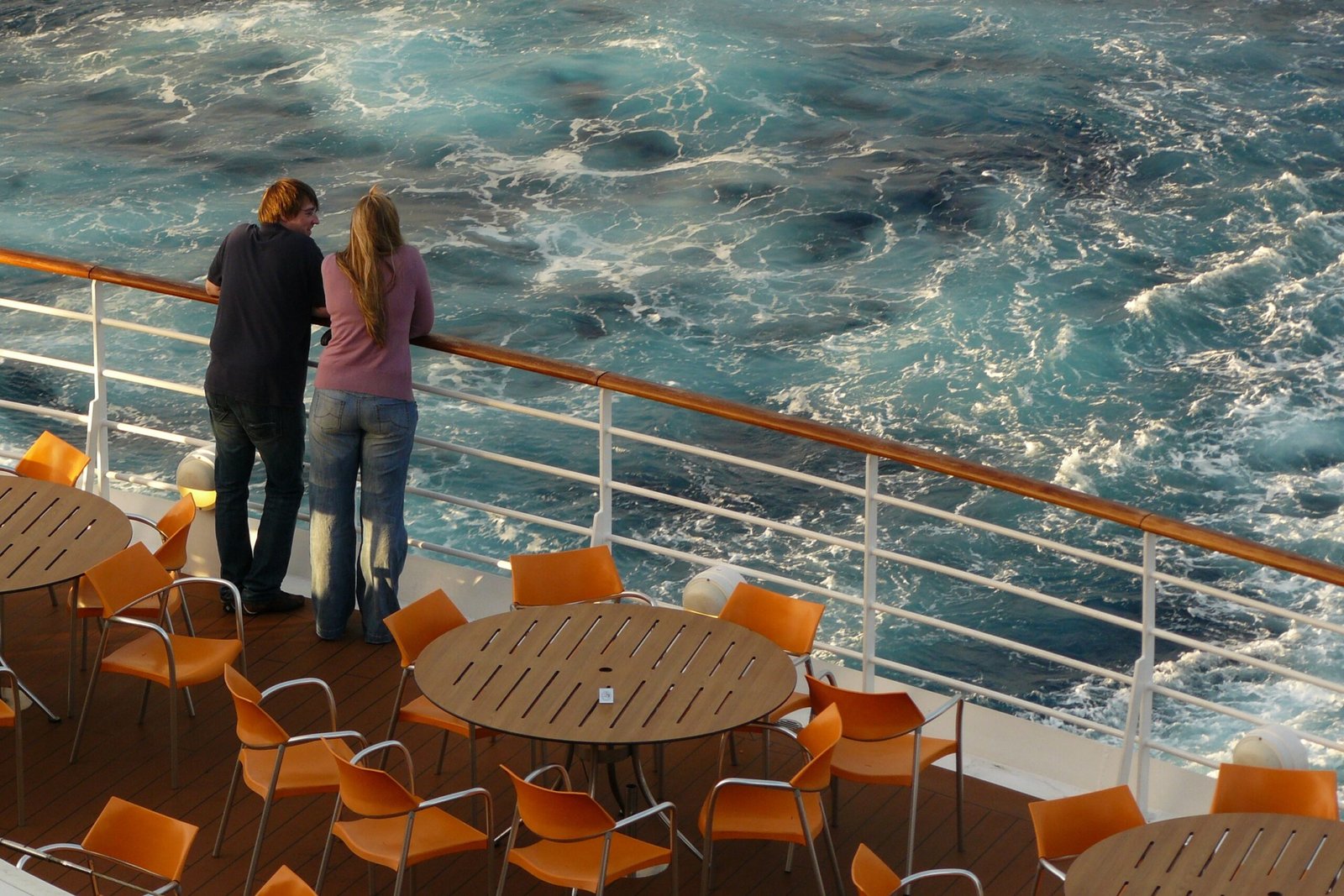
Cruise ships offer many places that feel intimate: a corner table, a deck chair, a quiet railing at sunset. But none of these belong to anyone.

People who treat shared spaces as temporary gifts tend to enjoy them more. People who try to claim them — early towels, guarded chairs, territorial looks — usually end up tense. This is one of the most common examples of cruise passenger behavior that quietly affects everyone onboard.
Many of these behaviors are learned from the very first day onboard:
👉 Embarkation day on a cruise
The ship is generous, it just does not reward ownership. I have encountered this type of tourist on many cruises — waking up at a frightening hour, throwing a towel on certain deck chairs — some closer to the pool, others looking for those near the bar or where they noticed more shade. After that they disappeared for hours, probably to sleep. And for hours — those deck chairs remained, somehow, empty.
Rule #2: Volume travels faster than you think
Sound behaves differently at sea, laughter travels far. Conversations spread, music slips through corridors more easily than you would expect.
It is not about silence, cruises are lively places. It is about awareness, about trying to behave, in the end, just like at home, trying not to disturb. Understanding how to behave on a cruise often starts with small things like this.
People instinctively lower their voice in enclosed spaces, late at night or near cabins. Not because they are told — but because they notice how sound travels. On a cruise near Mexico, a rather party-loving Irish young man had made it a habit — he would enter his cabin close to dawn, when alcohol was doing its thing. One night, two, three — until a tired father drew his attention.
Rule #3: Staff time is real time
Crew members are extremely polite. This can create the illusion that their time is elastic, but, in reality, it is not.
People who treat interactions with staff as brief, clear and respectful move through the ship more easily. Those who linger unnecessarily, repeat requests or test patience often feel friction — even if it is not expressed. This is part of the broader cruise behavior that experienced travelers quickly understand.
Courtesy is not just kindness, it is efficiency.
Rule #4: Lines are negotiated quietly
Queues exist on cruise ships, even when they are not marked. Whether we are talking about elevators, buffets, guest services, tenders.
This becomes especially clear on days when logistics are more complex, such as tender ports:
👉 What is a tender port on a cruise
People read body language, observe order. They understand who arrived when. Jumping ahead rarely causes confrontation — but it causes something worse: silent disapproval. Do not forget that on a ship, social feedback is subtle, but constant. These are cruise social rules that most people follow without thinking.
Rule #5: Not everything needs commentary
Cruises bring together thousands of people from different places, backgrounds and habits. This creates moments of contrast. Most people quickly learn that not every observation needs to be said, not every difference requires an opinion. Silence, in many situations, keeps things pleasant.
This is not suppression, it is coexistence. We are different, thank God, but that does not mean that our difference is more special than others’ difference. For many beginners, this becomes one of the most important cruise tips for beginners to understand early.
Rule #6: The ship has a rhythm — follow it
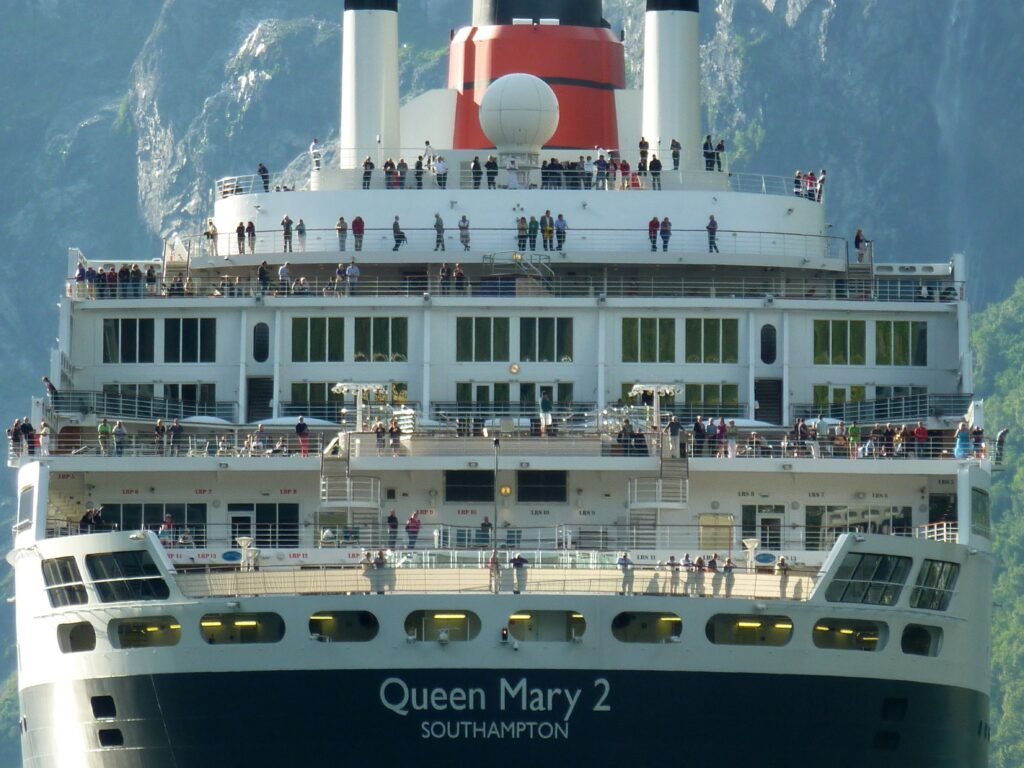
Every cruise develops its own rhythm. Meal times, show times. Peak movement moments, quiet intervals, all of these actually form the cruise.
This rhythm becomes even clearer when you understand how a full cruise day unfolds and how a small object controls your entire cruise
👉Cruise cards: the small object that controls everything on the ship
People who fight this rhythm — constantly rushing or resisting natural slowdowns — often feel tired. Those who align with it feel carried. Ignoring this is one of those subtle examples of what not to do on a cruise.
The ship does not rush, it glides on the waters, it crosses, it moves forward, it lives its own course and breaks the waves without hesitation.
Rule #7: Privacy is respected until it is no longer requested
Onboard, people are generally open, but not intrusive. Conversations start easily, they end just as easily. This balance really matters. When someone signals withdrawal — through body language, short answers or silence — others usually respect it.
Cruises work socially because exit is always possible. If you allow me a short parenthesis — it is like in everyday life, nothing else, nothing more or less. We just need to respect some basic common-sense rules. This is a core part of cruise etiquette, even if nobody explicitly calls it that.
Rule #8: Complaints travel downward
When something does not go well, the first person you speak to is rarely responsible for that thing. Experienced cruisers understand this instinctively and frame their problems calmly. They ask, they do not accuse. And the result is almost always better.
Cruise ships are systems, pressure travels downward.
Why these rules are rarely explained
Well, because there is no need. Most people adapt quickly. The ship’s environment encourages cooperation more than enforcement. When thousands of people share a moving space, mutual adjustment becomes the norm.
Written rules manage safety, quiet rules manage comfort — and together they define what cruise rules really feel like in practice.
What happens when someone ignores them
Nothing dramatic. There are no announcements, there are no confrontations. Just a subtle shift. Fewer smiles, shorter interactions, less willingness to help. In fact, on a cruise ship, social friction is felt more than expressed.
A simple way to look at things
Cruises work best when everyone assumes good faith. This assumption creates patience, which, in turn, creates flow. And flow is what makes life onboard feel surprisingly easy.

Common questions about cruise etiquette
Are these rules universal?
For the most part, yes. Culture changes details, not principles.
Do people ever break them?
Of course. And the ship absorbs it.
Is it stressful to think about them?
No. Most of it happens instinctively.
Do experienced cruisers consciously follow them?
Not really. They have just internalized them.
TL;DR: cruise etiquette in simple terms
Cruise etiquette is about shared space, awareness and rhythm. Most rules are not enforced, but naturally followed by passengers to keep life onboard smooth.
Final thought about cruise rules
The quiet rules of a cruise are not about restriction. They are about making a shared space feel lighter, calmer and more human than you might expect from a floating city.
Once you notice them, you will see how naturally most people follow them — and how much smoother everything becomes when they do