Why cruise ships feel smaller after the first day (and how you stop getting lost)
Cruise ships often feel much smaller after the second day, and this happens to most passengers. The shift usually appears within 24 to 48 hours, once your brain starts mapping the space through repetition, familiarity and reduced cognitive load. What feels confusing at first quickly becomes predictable, and movement across the ship turns almost automatic. This is a common part of the cruise ship experience, especially for first-time passengers who are still getting used to the cruise ship layout, cruise ship navigation and overall cruise ship environment.
For many passengers, this feeling starts during embarkation day, when cruise boarding and first navigation around the ship can feel overwhelming.
Why cruise ships feel smaller after day two – quick answer:
- Your brain maps the ship through repetition
- You stop relying on signs and start moving automatically
- Familiar places replace deck numbers
- You recognize routes, elevators and key areas
- Anxiety drops, making space feel smaller
What is it like on the first day on a cruise ship
The first day on a cruise ship, also known as embarkation day cruise, is usually the most confusing part of the entire cruise ship experience. This is when passengers are introduced to the cruise ship layout, cruise ship decks, cruise ship corridors and the general system of cruise ship directions and orientation.
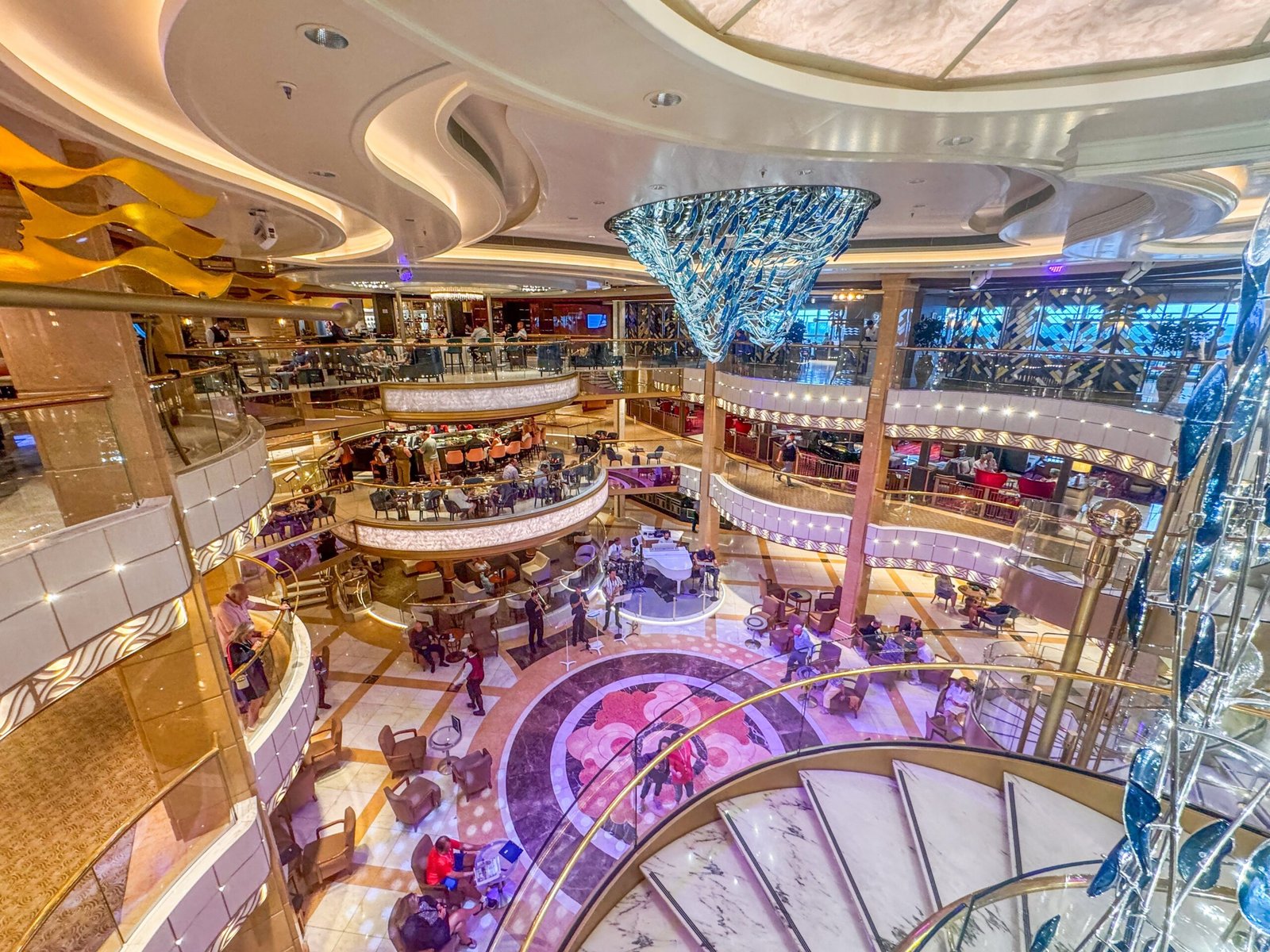
On the first day, a cruise ship feels enormous, corridors are longer than you expect, elevators seem to lead everywhere except where you want to go. Deck numbers feel abstract, and directions sound more like coordinates than places.
My God, how good it would have been if I had known on my first cruise at least 20% of what I know now, after a few years of wandering seas, oceans, countries and islands. And, to be honest, I only get to keep doing this if I actually work, so I figured I might as well help you, explain things clearly and give you a few shortcuts.
There is no point in panicking, you have no reason to seem confused after you have walked a bit around the ship. The truth is that your mind has not mapped everything yet. And then, usually somewhere on the second day, something changes.
This is why many first-time cruisers ask what happens on a cruise during the first day and how long it takes to get used to the ship.

Why cruise ship navigation feels difficult at first
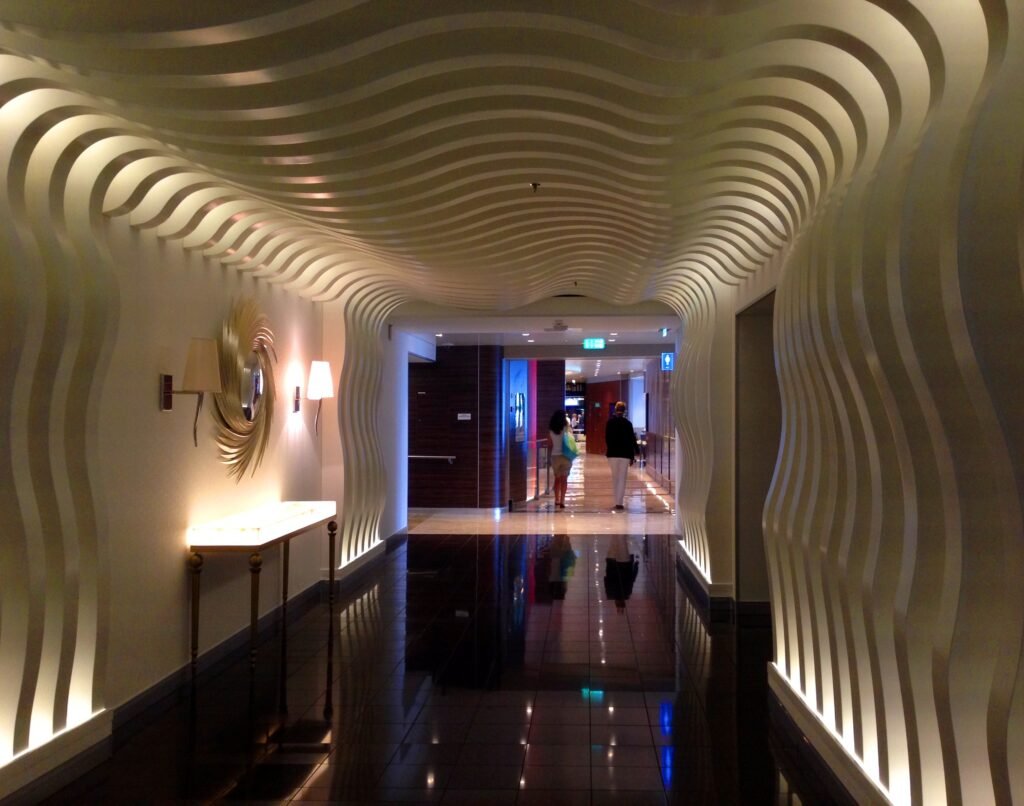
Cruise ship navigation can feel difficult at the beginning because passengers are exposed to a completely new environment, with multiple cruise ship decks, cruise ship corridors, elevators and routes that are not yet familiar. This creates a temporary cruise ship learning curve.
The moment it happens
You don’t notice this change immediately, you just realize that you didn’t stop to check a sign, that you turned left without thinking or that you reached your cabin without counting decks. And suddenly, what seemed almost impossible to understand has started to resemble the calm of a hotel or even your own street. Nothing is imposing anymore, huge, gigantic and the things you need start to get closer.
The ship did not shrink, your understanding expanded, the way you see everything, the way you look at decks, elevators, restaurants, everything that this ship has to offer.
How cruise ship layout becomes easier to understand
Understanding the cruise ship layout becomes easier once passengers repeat the same cruise ship routes multiple times. Cruise ship corridors, decks and elevators begin to form a mental map, making cruise ship navigation more intuitive.
How long does it take to get used to a cruise ship
Most passengers need between one and two days to feel comfortable navigating a cruise ship. The biggest change usually happens after repeated movement through the same areas, when routes start to feel familiar rather than confusing.
Why cruise ships feel confusing on the first day
The first day on a cruise can feel overwhelming because everything is new at the same time. New space, new rules, new rhythm. People you have never seen in your life are, somehow, next to you, they have the same expectations, they try to discover just like you.
Your attention is split between orientation and emotion. You learn where things are, while you process the fact that, finally, you are here. This cognitive load makes spaces feel bigger than they are. Between us, it is really not about distance, it is rather about unfamiliarity.
The first day on a cruise ship is not just about excitement, but also about understanding the cruise ship layout, decks and navigation system.
Is it normal to feel lost on a cruise ship
Yes, it is completely normal to feel lost during embarkation day. Even experienced travelers may need time to adapt, especially on larger ships where layout and structure take time to understand.
How repetition changes perception
By the second day, repetition quietly takes over. You have walked the same corridor a few times, you have used the same staircase, you have eaten in the same area. And yes — you already know how to get to the elevator you are looking for, because you have used it before. And after you got into it, you know exactly which deck you need to go to, where exactly you want to get.
Repetition turns space into sequence, sequence turns space into memory. Once that happens, movement becomes automatic, and when movement becomes automatic, places feel closer together.
At some point, you stop thinking about it. This shift is not only about space, but also about how you experience time. As navigation becomes easier, your perception of time starts to change as well, often without you even noticing it..
How cruise ship routes and movement become automatic
Once passengers start repeating the same cruise ship routes, movement becomes automatic. Cruise ship navigation no longer requires conscious effort, and the cruise ship structure begins to feel logical rather than complex.
Do cruise ships always feel smaller after a few days
In most cases, yes. Once familiarity and repetition take over, the ship feels more like a known environment rather than a complex structure. However, the speed of adaptation can vary from person to person.
The ship starts having “areas,” not just decks
At first, everything is labeled numerically.
Deck 5.
Deck 9.
Deck 14.
After a day or two, those numbers disappear, you start thinking in terms of:
- “the coffee place”
- “the quiet corner”
- “that lounge near the stairs”
The ship stops being a grid and starts being a set of lived-in areas. Then it feels smaller — and more personal.
Familiar faces also play a role
Another subtle factor is recognition. You begin to see the same people again:
- at breakfast
- near the pool
- on the same routes
This creates a sense of familiarity, of normality, if you allow me — of a bigger, more twisted hotel, but in which there is no way not to find everything you need, at any moment of the day or night.
When faces repeat, space contracts. The ship starts feeling less like a crowd and more like a temporary neighborhood.
Why elevators suddenly make sense
On the first day, elevators feel random, they seem to go somewhere, but almost never where you need. On the second day, you understand:
- which ones are faster
- which decks are the busiest
- when to use the stairs instead
This knowledge is not something you learn in a course, it is not a muster drill, it is absorbed. And once you stop waiting unnecessarily, the ship instantly feels easier to manage.
Once you understand how cruise ship elevators and decks work, moving around becomes much easier.
You don’t even realize when it clicks.
Emotional familiarity matters too
Physical navigation is only part of the change. So, by the second day, you have also accepted the environment.
You no longer:
- check announcements constantly
- look for instructions
- wonder if you are doing something wrong
This mental relaxation reduces perceived complexity. And when anxiety drops, space contracts, time becomes your friend and the entire ship turns into your own pocket, into something you know well.
How cruise ship environment and routine change perception
The cruise ship environment becomes easier to navigate as passengers develop a routine. Familiar routes, repeated experiences and predictable movement patterns reduce complexity and improve orientation.
Why this happens faster on cruises than in cities
In a city, repetition takes weeks, on a ship, it takes days. That is because:
- the environment is limited
- routes repeat naturally
- choices are limited in a good way
You don’t have to constantly decide where to go, you simply move within what already exists.
When the ship feels big again
Interestingly, the ship feels big again near the end. Not because you are lost — but because you start noticing spaces you haven’t used, spaces you will regret (this is a truth few tell you), even though you haven’t even experienced them, you haven’t been aware of them.
A feeling appears: “Oh, we never went there.” It is not regret, it is proof that the ship has always been bigger than your routine and it usually comes together with the desire to return as soon as possible, to experience something else, something else that was there, right under your eyes.
What this shift changes about the cruise
Once the ship feels smaller, you move more freely, you explore effortlessly, you no longer spend energy on orientation. This frees your attention for other things — conversations, views, moments you might have missed before. And, without realizing it, the cruise becomes deeper when movement becomes effortless.
Frequently asked questions
Does this happen on every cruise
Yes, regardless of the ship’s size. The effect is linked to how the brain processes space and familiarity, not to the physical size of the ship itself.
What if I still feel lost after a few days
That is completely normal. Some ships are significantly larger or more complex, and adaptation can take longer depending on how much you explore.
Do experienced cruisers feel this shift faster
Usually yes. People who have been on cruises before tend to recognize patterns more quickly and adapt faster to the environment.
Is it bad if the ship never feels small
Not at all. It simply means you continue to explore new areas or that your perception of space remains broader.
Why do cruise ships feel overwhelming at first
Because your brain processes a large amount of new information at once — layout, directions, people and expectations — which increases perceived complexity.
A curiosity instead of goodbye
Cruise ships do not actually become smaller, you simply start to become part of its life, of a routine. And when that happens, space stops being something you have to manage and starts being something you move through — calmly, without effort, as if it had always been familiar.
As a final piece of advice I can tell you — try to enjoy everything that happens, even a wrong deck, a path you mixed up, because, in the end, you are on a vacation, not in a full rush where you just have to check things or objectives